

Kentuckians can anticipate a likely vote to further reduce state taxes on individual income when the General Assembly reconvenes for the 2025 legislative session in January.
This afternoon, State Budget Director John Hicks announced at a meeting of the Interim Joint Committee on Appropriations and Revenue that the state had met the “revenue conditions” outlined in state law to allow the legislature to consider a vote to reduce individual income taxes. If the legislature acts in the 2025 session, Kentucky’s individual income tax rate could fall to 3.5 percent in January 2026. This equates to about $600 million in reduced state income taxes for Kentucky taxpayers.
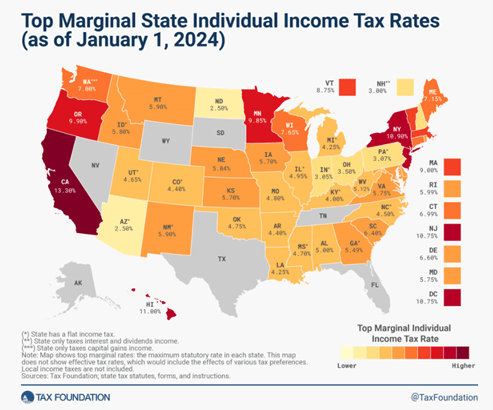
Kentucky is one of 41 states that levy taxes on individual income and one of 12 states that uses a flat income tax structure. Other states with individual income taxes use variable rate structures. Nine states, like Tennessee, do not levy taxes on individual income (with some exceptions).
A flat income tax rate of 3.5 percent would put the Commonwealth in a strong position to compete with regional states for high-skill workers, businesses, and entrepreneurs. Pro-growth tax reform – which emphasizes reducing taxes on individual income – is the top priority of the Kentucky Chamber of Commerce.
“Today’s news is the result of hard work by Kentucky’s leaders and the Chamber’s steadfast advocacy,” said Ashli Watts, President and CEO of the Kentucky Chamber. “Reducing the income tax is the Chamber’s top priority and will help make Kentucky more economically competitive. We look forward to working with the General Assembly in 2025 to pass legislation to continue the progress we have made on tax reform.”
In the 2022 session, lawmakers passed House Bill 8, which established in statute a process for gradually and carefully reducing individual income taxes. This legislation directed the Office of State Budget Director to conduct an analysis of two specific measures at the end of each fiscal year. First, the state’s Budget Reserve Trust Fund must be equal to 10 percent of state receipts. Second, receipts for that year must exceed state appropriations by the equivalent of a 1 percentage point reduction to the individual income tax rate. If both of these conditions are met, then the General Assembly may consider a 0.5 percentage point reduction to the income tax rate in the next session. Assuming a bill is passed, that rate reduction would take effect at the start of the next calendar year.
Since 2022, lawmakers have reduced individual income taxes from 5 percent to 4 percent, setting up taxpayers to be relieved of more than $1.2 billion in income taxes per year. The General Assembly first began working to reform Kentucky’s tax code in the 2018 session, with legislation to modernize corporate income taxes, broaden the sales tax base, and institute a flat individual income tax, which resulted in a reduction from about 6 percent to 5 percent for most taxpayers.
As a result of this work, the Tax Foundation updated Kentucky’s business tax climate from 37th in the nation in 2018 to 18th in 2023. Competitor states like North Carolina and Indiana outrank Kentucky, at 9th and 10th, respectively. But Kentucky is inching closer to 15th ranked Tennessee and 12th ranked Missouri. The Commonwealth’s tax competitiveness has surpassed states like Ohio, West Virginia, and Illinois.
While policymakers have pursued the important work of state tax reform, the state budget has continued to grow, allowing for critical investments in priority areas like education, economic development, child care, public safety, and workforce training. Last session, lawmakers appropriated $2.7 billion from the state’s Budget Reserve Trust Fund on education, infrastructure, and health care projects. With this spending accounted for, the Office of State Budget Director projects a budget reserve trust fund balance of $3.5 billion at the end of fiscal year 2026.
The Kentucky Chamber has been at the forefront of pro-growth tax reform advocacy in the Commonwealth. This work has included a close partnership with the Tax Foundation that featured a comprehensive tax reform guide in 2021 and a study of Kentucky’s sales tax base in 2024. The Chamber has also published a guide to House Bill 8, produced a report on how tax reform can grow Kentucky’s economy, and highlighted the importance of tax reform in Kentucky’s Winning Strategy, a long-range vision plan to move the Commonwealth forward.
The Office of State Budget Director recently released a more detailed report on the House Bill 8 revenue condition requirements. Review the report here.

Be the first to comment on "Kentucky to continue lowering income taxes, according to new state budget information"